Wednesday, March 01, 2006

Citizen Healer, Do No Harm, Published in Ventura County Star, 3/5/06


March 1, International Death Penalty Abolition Day

In 1828 Patrick Fitzpatrick of Detroit was executed for the rape and murder of an innkeeper’s daughter. Seven years later, his roommate confessed to the crime.

As a result of this and other travesties of justice, the first official act of the new state of Michigan’s legislature was to ban the death penalty.

On March 1, 1847, Michigan became the first English-speaking government in the world to outlaw executions. Now we commemorate March 1 as International Death Penalty Abolition Day.

The struggle to abolish the death penalty began around the same time as the movement to abolish slavery. The first independent government in the world to ban the death penalty permanently was the Grand Duchy of Tuscany in 1786. Today slavery is a crime everywhere on Earth, but the struggle to abolish the death penalty continues.

The US remains one of the few remaining bastions of democratic support for the death penalty. One hundred and twenty nations, from Angola to Nepal to Venezuela have no capital punishment. No European country executes its citizens, nor do our neighbors, Canada and Mexico. The UN has repeatedly endorsed an international moratorium on capital punishment.

Eventually, we as a nation will learn to respect the universal human right to life. We too will reject execution as a form of torture.

There are reasons for national optimism. In 2002 the Supreme Court declared the execution of the mentally disabled unconstitutional; the execution of juveniles was abolished in 2005. Like Michigan, twelve states have no capital punishment statute; Illinois and New Jersey have moratoria in effect, and the death penalty laws of Kansas and New York have been nullified. Many mainstream religious institutions in the US oppose capital punishment as a violation of the right to life. Recent polls suggest that voters prefer life without parole as an alternative to the death penalty, and as we saw last week in California’s Michael Morales case, the medical profession finds it ethically unacceptable for a healthcare provider to participate in executions.

The arguments in favor of capital punishment in the US are weak. It is excruciatingly obvious that executions do not deter capital offenses, are frequently meted out to factually innocent individuals, are racially biased, and function as a macabre lottery stacked against the most destitute defendants.

But the best argument against the death penalty may simply be what Jesus, the archetypal victim of the death penalty, taught: love thy enemy.

When we choose instead to wage “war on crime,” to hate and seek revenge, our empathy atrophies and we neglect to provide the early intervention alternatives to guns, drugs,
unemployment and gangs that are indispensable to sustaining a just and peaceful society.

A society committed to nonviolence and human rights would not be a leading purveyor of capital punishment, rivaled only by the likes of China, Vietnam and Iran. It would not be the world’s leader in per capita incarceration; nor would it have a homicide approximately every 30 minutes, as the US does today.

As we mark Wednesday’s International Death Penalty Abolition Day, let us contemplate what it would be like to wage peace, instead of war, on crime. What if our guiding principles were compassion and rehabilitation instead of vengeance and punishment? What if we all considered ourselves the healthcare providers of future generations, nurturers of the sanctity of human life, citizen healers who refuse to participate in any killing, even when authorized by the state?

Tuesday, February 21, 2006

Waging Peace on the Death Penalty, Published 2/20/05


NOTE: Mr. Morales was given a last-minute reprieve when two anesthesiologists refused to participate in the execution. He remains under a death sentence as a Federal Appeals Court considers the protocols of execution in the state of California.

Waging Peace on the Death Penalty

At 12:01 a.m. Tuesday morning Michael Morales is scheduled to die for the 1982 murder of Terri Winchell, a 17-year old Lodi, California high school student.

The trial took place in Ventura County, where I live.

This evening, as Michael is strapped to the executioner'’s table, Amnesty International and Citizens for Peaceful Resolutions will hold a candlelight vigil in front of the Ventura County Government Center, where Morales was condemned to death. We will call for the abolition of the capital punishment.

Michael Morales has lost his struggle to survive, but eventually we death penalty abolitionists will prevail in the United States as we have prevailed in 120 other countries, from Angola to Nepal to Venezuela. Eventually, we as a nation will learn to respect the universal human right to life. We will reject execution as a form of torture.

There are signs that the tide is turning against capital punishment. In 2002 the US Supreme Court declared the execution of the mentally disabled unconstitutional; the execution of juveniles was abolished in 2005. Twelve states have no capital punishment statute, and Illinois and New Jersey have moratoria in effect. Recent polls suggest that voters prefer life without parole as an alternative to the death penalty.

The rational arguments in favor of capital punishment are weak. It is excruciatingly obvious that executions do not deter capital offenses, are frequently meted out to factually innocent individuals, are racially biased, and function as a macabre lottery stacked against the most destitute defendants.

But the best argument against the death penalty may simply be to see Michael Morales as a fellow human being worthy of our care and compassion. Although these humanistic arguments were ignored by Governor Arnold Schwarzenegger when he rejected Morales'’ clemency petition, Michael is remorseful and rehabilitated. He is a talented and sensitive artist. He has a mother, a father, two brothers, a sister, three children and young grandchildren who will be no less devastated by his murder at the hands of the state than Terri Winchell'’s wonderful and loving family has been by her murder at the hands of Michael and his accomplice.

I will hold two candles tonight—one for Terri and one for Michael. I believe it is only through honoring both these lives, loving both these souls, that we can finally come to grips with our residual national resistance to abolition.

It easy to love a young woman like Terri Winchell; I know because I have two equally lovable teenage daughters. It'’s a lot harder —but just as important—to love Michael Morales. When instead we hate Michael and men like him, we neglect to provide early intervention alternatives to guns, drugs, unemployment, gangs and prison.

Father Gregory Boyle, who has devoted his life to working with youth at risk for violent crime, particularly minority males like Michael Morales, says that Jesus always represented "the poor and excluded, the easily despised, the demonized, and those whose burdens were more than they could bear."

Michael Morales—so easily despised and demonized for the horrific murder he committed at age 21 while stoned on marijuana, PCP and embalming fluid—fits the profile perfectly.

Father Boyle says such youth don'’t need a second chance; they need the first chance that no one ever gave them.

Our "war on crime"” has made us the world'’s number 1 per capita incarceration country with over 2.1 million prisoners. We are a leading purveyor of capital punishment, rivaled only by the likes of China, Vietnam and Iran. We have implemented astonishingly draconian measures like California'’s heinous Three Strikes Law which provides a life sentence for offenses as minor as stealing a couple of DVDs or lying on a driver's license application.

As we mourn Terri and Michael'’s death, and as we approach March 1, International Death Penalty Abolition Day, let us contemplate what it would look like to wage peace, instead of war, on crime. What if our guiding principles were compassion and rehabilitation instead of vengeance and punishment?

Our first step would be to abolish the death penalty and to give Michael Morales his first chance.

Saturday, February 18, 2006

Posthumously Yours, Stanley Tookie Williams, Published 12/20/2005


Posthumously Yours,
Stanley Tookie Williams*

Dear Arnold,

I’ve been dead for a few days now. You’ve probably already forgotten about me and moved on to more important matters like condemning gay marriage, helping the Minutemen keep Mexicans out of California, and preparing another diatribe to deny clemency to Clarence Allen, the 76-year-old blind Choctaw Indian you’ll execute on Jan. 17.

Still, I beseech you—once again—to take just a moment from your busy schedule. I have something important to tell you:

I forgive you for murdering me.

Here’s why:

First of all, Arnold, I forgive you, because I realize you are a kind of ventriloquist’s puppet, a stooge for special interests that couldn’t care less about individual lives like mine or those of the at-risk youth I would have continued to help had I lived.

You, Arnold, merely gang-bang for the military-industrial-prison complex that has turned the US into the per capita incarceration capital of the world, a country only outdone in executions by Iran, China and Vietnam.

Secondly, I forgive you because I understand that shallow and craven men can’t really be blamed for lashing out as you did.

That’s what Jesus meant when he said, “Forgive them; they know not what they do.” You know not what you do. You don’t get it. You don’t get what’s wrong with state-sanctioned ritual murder. You don’t get why rehabilitation and redemption are better than blood vengeance and draconian punishment. And you don’t get why so many people thought my trial was hopelessly tainted by racism.

Third, I forgive you because it’s not for me to judge. Ultimately, Arnold, you don’t answer to Stanley Tookie Wiliiams. You answer to history. Time will tell who will be redeemed and who condemned. My legacy is a series of beautiful children’s books. What’s yours?

Fourth, I forgive you because I too must take responsibility for your empowerment. There’s some wisdom in the proverb, “The people get the government they deserve.” Our apathy, lack of political organization, appetite for simpleminded diversion, misdirected rage and despair have helped you win an election and promote the political agenda that brutalizes us all.

Fifth, I forgive you because I refuse to seek revenge on my fellow human beings. After my redemption, I lived for reconciliation, healing and justice. I took a vow never to hurt anyone. That’s something you, Arnold, might also consider.

Sixth, I forgive you because I never give up hope. Even though you murdered me to serve your petty ambitions and uphold the perverse values of your cronies, I hope and pray you may still learn to do the right thing. Trust me, there are always opportunities for redemption, even for you. It’s never too late to renounce violence and injustice.

Finally, I forgive you, Arnold, because I have compassion for your soul. I know that deep down inside you there is a goodness that suffers because you murdered me. I no longer have time to figure out how you became the wounded narcissistic megalomaniac that you are, but I know it’s not the real you. You’re better than that, Arnold. May God have mercy on your soul.

*Stanley Tookie Williams was channeled by David Howard, a peace activist and writer who held a candle for Tookie at the Ventura County Government Center on the night of the execution. DavidHoward@aol.com

Wednesday, February 01, 2006

In Honor of Terri Winchell, Don't Execute Michael Morales, Published in VC Star, 1/22/06


On Thursday, Jan. 8, 1981, Barbara Christian was sick in bed. Her 17-year-old daughter, Terri, a senior at Tokay High School in Lodi, went out to buy dinner. She never came back.

At 2:00 a.m. Saturday, police found Terri’s body in a vineyard on the outskirts of town. She was naked from the waist down; her shirt and bra were pulled up over her chest. She had been hit in the head 23 times, mostly with a claw hammer. Her skull was shattered. Her cheekbones and jaw were broken. She had four stab wounds in her chest.

Terri Winchell should be 42 years old today. She should have gone to college; she should have had the opportunity to be a mother, an aunt, a friend, a lover. She should have had a rich, meaningful life. Instead, she never saw her 18th birthday.

Michael Morales and Rick Ortega were found guilty of this heinous crime. Ortega got life in prison and Morales—tried and convicted in Ventura County—is scheduled to be executed on February 21 at San Quentin Prison.

We cannot know what it’s like to be Barbara Christian, to survive the murder of a daughter. It’s almost obscene to ask.

So we must mourn for Terri and all the other victims of our national homicide epidemic. We must listen carefully to the families of murder victims. We must provide them the special services they need; we must help them heal, and we must protect society from other murderers.

But we must not execute Michael Morales. Or anyone else.

We need no longer dispute the troubling aspects of the Morales case. Let’s assume there was no jailhouse informant conveniently placed in a cell opposite Morales’ and rewarded with a sentence reduction. Let’s assume there was no perjured testimony given under duress and recanted 10 years later. Let’s assume the dissent to overturn this verdict by a State Supreme Court justice on grounds of a racially discriminatory jury pool is irrelevant. Let’s assume it’s just a coincidence that among the three California executions over the past three months one was an African American, one an American Indian and one a Latino. Let’s assume that indigents get the same quality of legal representation as wealthy people. Let’s assume that Morales should get a death sentence, while his cousin who planned and helped carry out the crime, should not. Let’s assume that a quarter of a century between arrest and execution is not too long. Let’s assume that there is nothing better to spend our billions of taxpayer dollars on than sustaining this whole macabre and excruciatingly painful process.

Let’s assume there is no reasonable doubt.

The question remains, should we, at the execution hour of 12:01 a.m. on February 21, care if Michael Morales lives or dies?

The answer is yes. We cannot ignore the intrinsic immorality of state-sponsored murder. If the right to life is a fundamental human right, it must apply universally, to all human beings.

We will always fall short in our efforts to honor human rights, to forgive, to reconcile, to rehabilitate and to heal. But we cannot, must not, institutionalize murder.

The only legitimate question to ask for Terri Winchell’s sake is how can we prevent the next rape, torture and murder of a 17-year-old girl. The answer is the hard work of education, prevention and intervention among both our at-risk and general population. Our disadvantaged communities in particular lack basic social services from pre-natal care through birth, infancy, childhood and adolescence. If we nurture our young in the ways of love and nonviolence, our violent crime rates will plummet.

“An eye for an eye,” said Gandhi, “makes the whole world blind.” He meant not only that warfare perpetuates a cycle of violence, but also that killing deprives us of a vital social sensibility—compassion. Capital punishment dehumanizes us. In avenging the murder, we become the murderers.

There are only three ways to deliberately kill another human being: murder, war and the death penalty. With a little effort we could quickly eradicate one of these scourges forever. Let’s do it in honor of Terri Winchell.

Amor for Fatima, Andrew and Anthony


Published in the Ventura County Star on 3/4/2005


AMOR means “Love” in Spanish. The acronym stands for Alternatives to the Military: Options and Resources. The AMOR group is composed of community activists, deeply troubled by the war in Iraq, who meet at Oxnard’s Café on A. We range in age from 20 to 80, and we include concientious objectors as well as veterans of WWII, Vietnam and other conflicts.

What we have in common is respect for the dead. Like Andrew Aviles, age 18, dead in Baghdad. Or Anthony Roberts, 18, dead in Al Anbar Province.

The long list of American teenage soldiers who have perished in Iraq demands our loving attention, but it would be obscene to memorialize their deaths without also acknowledging those who died by their hand. By our hand.

There is no list of Iraqi dead. Just estimates. Five thousand? Ten thousand? A hundred thousand? The Iraqi dead are nameless to us, faceless, almost incorporeal. Iraqi civilian dead are “collateral damage.” Accidents. Nobody’s responsibility. “Co-lateral” means off to the side. Not at center stage, not at the heart of the matter, not where the flag flies and the band plays. Extraneous. Out of sight, out of mind.

For months before the war many of us tried to remain mindful of the still-living Iraqi civilians. We wore buttons with the name and age of an Iraqi child: “Fatima, age 2.” A faith-based group in Massachusetts distributed the buttons. Pray for these children, they said.

In contrast to the nameless Iraqis, CNN has a website with our dead soldiers’ photos, names, hometowns and ages. It looks like a high school yearbook. Except the graduates are dead. It is those deaths that AMOR addresses. Pray for them too. And consider why they died.

Not why we waged war under false pretenses and in defiance of international law. Not why we elected a president too eager for battle. You already know that. What you may not know, however, is how our children were lured to this war.

Under a provision of a law whose very name, “No Child Left Behind,” is an unintended tribute to the atavistic evil of conscripting the young, every high school in the US is required to submit the names, addresses and phone numbers of all boys and girls in 11th and 12th grade for military recruitment purposes. It is possible to “opt-out” of the Defense Department’s recruitment hit list, but most kids and their parents don’t know that. Oxnard let two years lapse before they even began to inform parents that the Pentagon was compiling data about their children.

The military spent about four billion dollars of taxpayer money last year to recruit our children to the killing fields. Professional recruiters charm impressionable teens with glossy mailers and unsolicited phone calls. No Child Left Behind guarantees recruiters a competitive edge over other post-high school employment and education alternatives that are required by law to honor children’s privacy.

Military recruiters are also on our campuses with Junior ROTC programs. They show up for job fairs and career days, and at some schools they’re allowed to just “hang out,” schmooze the kids and give away trinkets: t-shirts, baseball caps, miniature toy rockets.

The military targets the poor and minorities for its bloody missions of putative glory. Jessica Lynch joined up and went to Iraq after she had been turned down for a job at Wal-Mart.

Recruiters promise kids job training, a college education, adventure and excitement. They promise to build character. Most of these promises are inflated and misleading. As Mose Allison used to sing, “Life is short and talk is cheap. Don’t make promises you can’t keep.”

Life was 18 years short for soldiers like Andrew and Anthony. What promises did recruiters break to them?

There are better, nonlethal ways to get job training and a college education, and there are peaceful ways to serve your community and your country. There is nothing glorious about war. War is a trick we play on our children, the quintessential broken promise.

Chris Hedges writes, “War is always about betrayal. It is about the betrayal of the young by the old, idealists by cynics, and finally, soldiers by politicians. Those who pay the price, those who are maimed forever by war, are shunted aside, crumpled up and thrown away. They are war’s refuse.”

AMOR challenge the notion of teenagers as refuse. We provide walk-in, telephone and online counseling services to youth looking for alternatives to the military, and we work to create peaceful employment, education and service options on high school campuses.

We do it for Andrew and Anthony, and we do it for Fatima.

Tuesday, January 31, 2006

Cafe on A


The paradox of holy places: they exist—spatially, materially,—but they’re also all in your mind. And heart.

This is a reflection on our sacred space in the heart of Oxnard—Café on A.

On March 14, 1979, twenty-five years before I met Café on A co-creators Armando Vázquez and Debbie De Vries, a pre-dawn earthquake off the coast of Guerrero rumbled through Mexico City and destroyed much of the Iberoamericana Univeristy where I worked. Had it struck a couple of hours later, the campus would have been teeming with students, teachers and staff. Because of the fortuitous timing hundreds of people lived who would otherwise have died.

When I got off the subway and arrived on campus that afternoon, I was shocked by the devastation. My classroom had been reduced to rubble. But more than the material catastrophe, what I remember most vividly are the signs posted and painted on the walls that remained standing. Anonymous muralistas had gone to work immediately to bring forth image and poetry from the ruins.

One graffiti was seared into my brain forever: La universidad no es un edificio. The univeristy is not a building.

It was the perfect aphorism for the campus existential crisis. We read it and went about the work of sustaining what the university really was—a community. I like to think that no one who experienced the jolt of earthquake and poetry that day ever again confused a building with its meaning, existence with essence.

The Jesuit founders of the Universidad Iberoamericana knew something about sustaining institutions. The best among them knew the secret of sacred space: build it with your heart, your soul and your integrity, and it will last. Earthquake proof. Even if it all falls down.

Paradoxically, the institutions that are built in full consciousness that they are not (merely) buildings tend to be the most beautiful, the most soulfully imperishable. Build them of brick, steel, silver and gold; or build them of wind, sand, mud and straw. The materials don’t matter. The heart of the matter matters.

Debbie and Armando have designed our beloved Café on A as a sacred space that’s in a building, but not of a building. And thus Café on A becomes the molten core, the epicenter of a different kind of earthquake. The kind that shakes asunder the foundations of injustice, that inspires artists to rock our world, that releases underground tectonic energy to radiate in mystery and transform lives.

Café on A is exactly where it’s supposed to be: on Oxnard’s spiritual faultline, on the frontera, in the circle whose center is everywhere, whose circumference is nowhere.

Que dure mil años. May it last a thousand years.

Friday, January 20, 2006

The Last Gospel, a historical novel published in 2000 by Discus Books


Combination thriller, wisdom quest, and futuristic love story, David Howard’s The Last Gospel is a richly textured and meticulously researched novel that infuses ancient religion with new meaning for a new millennium.

The Last Gospel takes the reader on a riveting journey that shifts on parallel plot lines from the 1st to the 21st century, juxtaposing the heroes, sages and villains of ancient Palestine with those of tomorrow’s hi-tech California.

In the year 2020 Pope Juan Diego, under the Vatican’s glasnost policy, releases a set of ancient scrolls the Catholic Church has held in secret for a thousand years. The documents contain first person accounts of the life of Jesus, told by those who knew him best.

Providing new and credible testimony, the "Isaac Scrolls" challenge core Judeo-Christian beliefs: Jesus had an Indian lover, a vengeful brother, a mother who was both sensuous and wise. Judas was framed by Peter. Mary Magdalene had an affair with Thomas, and Jesus leaves a final message for humanity in the hands of a teenager.

Just as Christians prepare to re-examine their most cherished beliefs, one of the key researchers on the project, Rafaela Baruch da Costa, a Sephardic-American Jew, pregnant by her expatriated African-American lover, begins to uncover prophecies encoded in the Scrolls. As her love life, career and family life careen out of control, and as she is menaced by Fundamentalist terrorists, Rafaela is inexorably led to the conviction that she must act resolutely to avert Middle Eastern catastrophe.

AVAILABLE IN HARDBOUND AND UNABRIDGED AUDIO:

Amazon.com


Sunday, January 15, 2006

Project Emancipation, Published in VC Star, 3/30/05


Project Emancipation

Gang injunctions must not be perpetual

The Oxnard gang injunction trial has come to an end, and the verdict is in the hands of the judge.

Public Defender Neil Quinn and civil rights attorney Gabriella Navarro-Busch have presented a compelling case to challenge the wisdom, constitutionality and effectiveness of the Oxnard injunction. It is my view that their arguments should prevail and the injunction should be rescinded. The injunction was a bad idea to begin with—the brainchild of an overzealous police chief who has since resigned.

Instead, we should devote our energies to providing the full range of educational, health, employment and rehabilitative services that we know can not only dramatically reduce crime rates but also improve the quality of life for all of us.

I was among a group of community activists who attended the injunction trial in Ventura County Superior Court. One interesting thing we observed is that every single person involved in this case was appalled by the extent of violent crime in Oxnard. That includes police officers, district attorney, civil rights activists, relatives of victims and alleged gang members, attorneys for the enjoined individuals, and expert witnesses for both sides. Everyone who set foot in Judge Byssche’s courtroom is strongly committed to reducing the murder and violent crime rate in Oxnard.

Our profound disagreement is not over the goal, but the means of achieving it. The proponents of the injunction have emphasized punitive measures, while the opponents have stressed social services and rehabilitation. We activists have argued that law enforcement must do its job without violating anyone’s civil rights. The district attorney insists, however, that some rights—like freedom of association— are worth circumscribing in pursuit of winning the “war on gangs.”

Despite these diverse approaches and philosophies, and despite the inherent adversarial nature of a trial, I hope we can find some common ground.

One area in which we may get consensus between community groups and law enforcement is Project Emancipation.

Activists for several peace and justice organizations have presented a proposal to the Court that provides a rehabilitative exit from the injunction. The need for such a strategy can be gleaned from District Attorney Karen Wold’s statement in the Star on 3/25/04: "People who are not even born yet can be served with this order 20 years from now.” The Oxnard Police Department’s Q&A on their website has a one-word answer to the question of how long the injunction will last: forever.

If you’re not alarmed, you ought to be. Consider this: Nothing prevents the Oxnard Police Department under current leadership or under whatever leadership it may have ten, twenty or fifty years from now, from jailing citizens for driving home from the movies after 10:00 pm or for crossing the street to visit a neighbor. There is no requirement that such a citizen have a criminal record. Indeed, Californians have already been enjoined by similarly crafted injunctions without ever having been arrested or even having been a suspect in a crime. All the police have to do is document that someone has accused you of being a gang member. A witch hunt? Potentially.

Project Emancipation would establish a rehabilitative alternative to incarceration and eternal surveillance. Enjoined individuals would be offered the opportunity to participate in a community-based program like Oxnard College’s KEYS Leadership Academy. The award-winning KEYS program has been enormously successful with Ventura County’s most challenging youth. KEYS gets at-risk young men and women enrolled in school, gainfully employed and involved in productive community-improvement projects.

The injunction would be temporarily lifted while alleged gang members are enrolled in an approved rehab program like KEYS and permanently lifted upon successful graduation. Respected community organizations like CAUSE and El Concilio, along with representatives from the police and probation departments, would provide oversight for Project Emancipation.

Currently, gang injunctions provide no incentive for enjoined individuals to get a job, go to school or contribute to the community. Project Emancipation does. Even if the injunction is rescinded in Oxnard, Project Emancipation can provide a rehabilitative model for past and future injunctions throughout the state and country.

Can anyone argue that jobs and college credit are not a more desirable outcome than jail?

Saturday, January 14, 2006

Oxnard Gang Injunction, A Distraction, Published in VC Star, 12/14/04


Oxnard Police Chief Lopez dismisses civil rights activists' objections to the gang injunction by claiming, "Our highest court does not contend the injunction is a violation of the rights of gang members." This misleading presumption of constitutionality deserves some scrutiny.


The Oxnard injunction, in citing more than 1,000 unnamed "Joe Does" and covering a vast expanse of the city, goes much further than the very narrow injunction against 33 named defendants that was upheld by the State Supreme Court in Gallo vs. Acuña. But even in the Acuña case, several justices were troubled by the limits on freedom of association. Justice Stanley Mosk, in fact, was outraged. He concluded his impassioned dissent by quoting U.S. Supreme Court Chief Justice Earl Warren: "Unfortunately, there are some who think the way to save freedom in this country is to adopt the techniques of tyranny."

In 1999, the U.S. Supreme Court rejected the use of such techniques of tyranny, even against gang members, ruling 6-3 that Chicago's anti-loitering laws were unconstitutional. The court determined -- with only Justices Antonin Scalia, Clarence Thomas and William Rehnquist dissenting -- that in a free society, police cannot be given unbridled authority to arrest citizens.

Police officers, the court said, need some evidence of wrongdoing before they intervene. There is, however, no wrongdoing in the behavior that has been arbitrarily criminalized under Chief Lopez's injunction. In his world, you can go to jail for wearing a Dallas Cowboys T-shirt. If the police chief wants to push the envelope on our civil liberties, he should be mindful of the consequences. The 1992 loitering law in Chicago resulted in 42,000 wrongful arrests of alleged gang members. Most of those arrested were black or Latino.

Is that the way to prevent violence in Ventura County? The experts in education and healthcare say no.

The gang injunction is a costly and counterproductive distraction from the violence prevention programs that nurture our children to grow up peaceful, loving, productive members of society.

Tuesday, January 10, 2006

Gang Injunction is Bad News for Oxnard, Published in VC Star, 11/21/2004

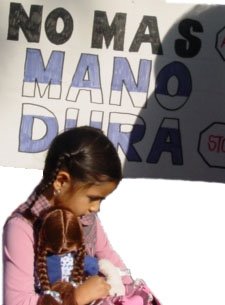
NO GANG INJUNCTIONS
No más mano dura


There's good news and bad news about the sweeping civil gang injunction imposed on 6.6 square miles of Oxnard.

If you view the glass as half empty, the situation may look pretty grim. Litigation is likely to cost the county a fortune; citizens misidentified and harassed as gang members are outraged, insulted and intimidated; constitutional guarantees like freedom of association and freedom of expression are eroding; and, worst of all, our persistent epidemic of violence is being treated with a placebo of hot air about "urban terrorists" and a counterproductive bludgeon of "tough-on-crime" ideology hellbent on celebrating our national disgrace of shattering the world's record in per-capita incarceration.


Rather than face the shame and failure of our disastrous policies of warehousing mostly minorities for mostly nonviolent crimes, our district attorney, who finds nothing objectionable in a law that provides life prison sentences for stealing a box of diapers, has cut and pasted a crude Los Angeles gang injunction on Oxnard.

The injunction hopes to achieve sweep-the-barrio incarceration of some 1,000-plus "John Does."

Today, young Oxnard Latinos can go to jail even for nonexistent "crimes" such as wearing a Dallas Cowboys T-shirt.

So what's the good news? Simply put, a grass-roots movement of violence prevention and rights protection has mobilized in powerful opposition to the injunction.

On the legal cutting edge of Oxnard's violence prevention movement, the Ventura County public defender is collaborating with pro bono attorneys to protect those served with the injunction and to address the troubling constitutional issues.

The judge, rather than compliantly issuing the blanket injunction that the district attorney pitched, has scheduled the case for January trial, denied a motion to expand it, and ordered mediation between community leaders and law enforcement.

At the same time, community activists who understand the root cause of street gang violence -- the failure to address marginalization at every critical juncture of a child and adolescent's life -- are educating public officials through demonstrations, neighborhood meetings and weekly appearances in City Council chambers.

New organizations such as Colonia Civil Rights Coalition and Chiques Community Coalition Organizing for Rights Education, Employment and Equity (CORE) have formed to help, rather than punish, at-risk youth before, during and after they get involved with la vida loca (the crazy life).

As a result of these organizing efforts, city and county officials have begun to take a second look at underfunded programs that are proved to reduce violence, like Oxnard College's KEYS Program for at-risk youth.

What the community activists understand is neither rocket science nor an assiduously guarded state secret. It is public knowledge, common sense and the hard science promoted and promulgated by the surgeon general, the Centers for Disease Control and Prevention, and the National Institutes of Health.

All those sources agree that youth violence must be addressed comprehensively by the entire "village" of healthcare professionals, educators, community activists, parents and survivors.

While popular media often delight in portraying gang youth as murderous scum beyond redemption, the profile of the gang banger is more typically a child hurt by racism and poverty, economically disadvantaged, learning-disabled, from a single-parent, immigrant home, or a succession of foster homes, where he or she may have been physically or sexually abused.

On the law-enforcement front, some Oxnard police officers are showing signs of understanding what Boston police chief Mickey Roache understood more than a decade ago when he participated in a community-based effort to reduce that city's juvenile murder rate to zero for the year 1996.

Chief Roache was honest and smart enough to publicly acknowledge, "You can give me all the police you want and build all the prison cells you can afford, but until you stop the flow of kids into violence, I cannot fix the problem."

Boston was successful because the experts viewed violence as a public health crisis, like tobacco addiction or automobile safety. The treatment included education, recreation, healthcare, substance-abuse rehabilitation, living-wage jobs, parenting workshops and psychological services.

To implement such a program, you don't need to build more prisons, criminalize freedom of association or enact draconian laws; you just need the compassion, creativity and commitment of concerned citizens like you and me.


Tuesday, January 03, 2006

Cecilia y yo

Mis Hijas / My Daughters


Hannah Angeles

and Eva Shoshana